
Keyword research, competitor analysis and Google Business Profile improvements focused on the markets and clients you want to reach.
Real Estate SEO Services That Get You Found.
Real estate SEO services that help buyers and sellers find you on Google and in AI answers. We build the pages, local presence and search strategy that help the right people find your business and reach out.
Book a CallSEO Built Around the Way
Your Clients Search.
For real estate teams, brokerages, homebuilders and developers. One connected search program, shaped around your market.
Someone Is Looking for Local Expertise.
Google Search
Google Maps
AI Answers
Your Website
Market & Service Hubs
Connected to useful local pages
Neighborhoods
Communities
Buyer & Seller Guides
Useful content · Clear structure · Credible sources
A Client InquiryA conversation with your team
Explore a Service to See Its Role.
Content writing and on-page SEO for neighborhood, community and service pages. Give buyers and sellers useful local knowledge and a reason to choose your business.
Fast, crawlable pages, clear internal links and structured data. Give search engines and AI assistants accurate information they can use.
Relevant link building and business mentions, with reporting on organic traffic, AI visibility and qualified leads. See what changes and what needs work.
Book a Free 30-Minute Call
Pick a time that suits you. Jacob reviews your current website before the call, so you leave with clear next steps.
Search and AI visibility starts from $2,500 a month, with a six-month minimum. Your website build or rebuild is included.
Your Call Is Booked
A quick note from Jacob before we meet.
Meeting Details
- What
- Formbreak Intro Call
- When
- See your confirmation email for the date and time.
- With
- Jacob Peistrup
Your confirmation email includes your calendar invitation, meeting link, and options to reschedule or cancel.
Prefer to start in writing? Send us a message.
Real Estate Websites We’ve Built
Team sites, community pages, relocation guides and buyer resources. Every site here is live. Tap any site to see it larger.
What This Work Did for One Real Estate Team
$65M+
Home sales, closed or under contract since 2021, from one St. Louis team’s inbound leads across YouTube, websites, community sites and AI search. Source: lead tracker, October 16, 2026.
Read the Case Study- 111 closed home sales tracked since 2021
- $19M 2026 contract volume, closed or pending
- 20,000+ YouTube subscribers

Gateway Realty Group
The flagship site for the St. Louis real estate team behind the Living St. Louis channel, with neighborhood guides and buyer and seller pages.
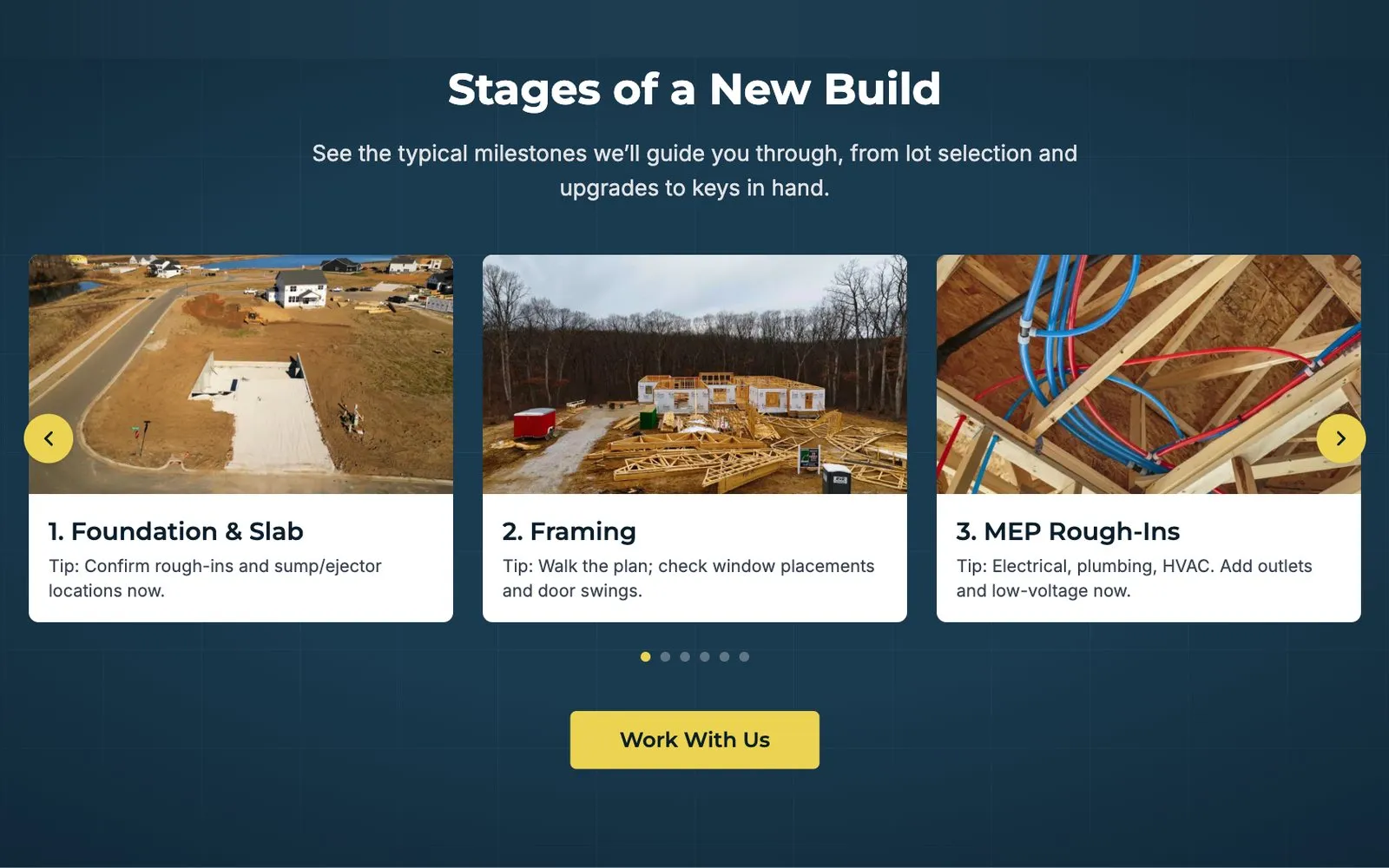
Stages of a New Build
A section of the Gateway Realty Group building guide that walks buyers through each stage, with a tip for every one.
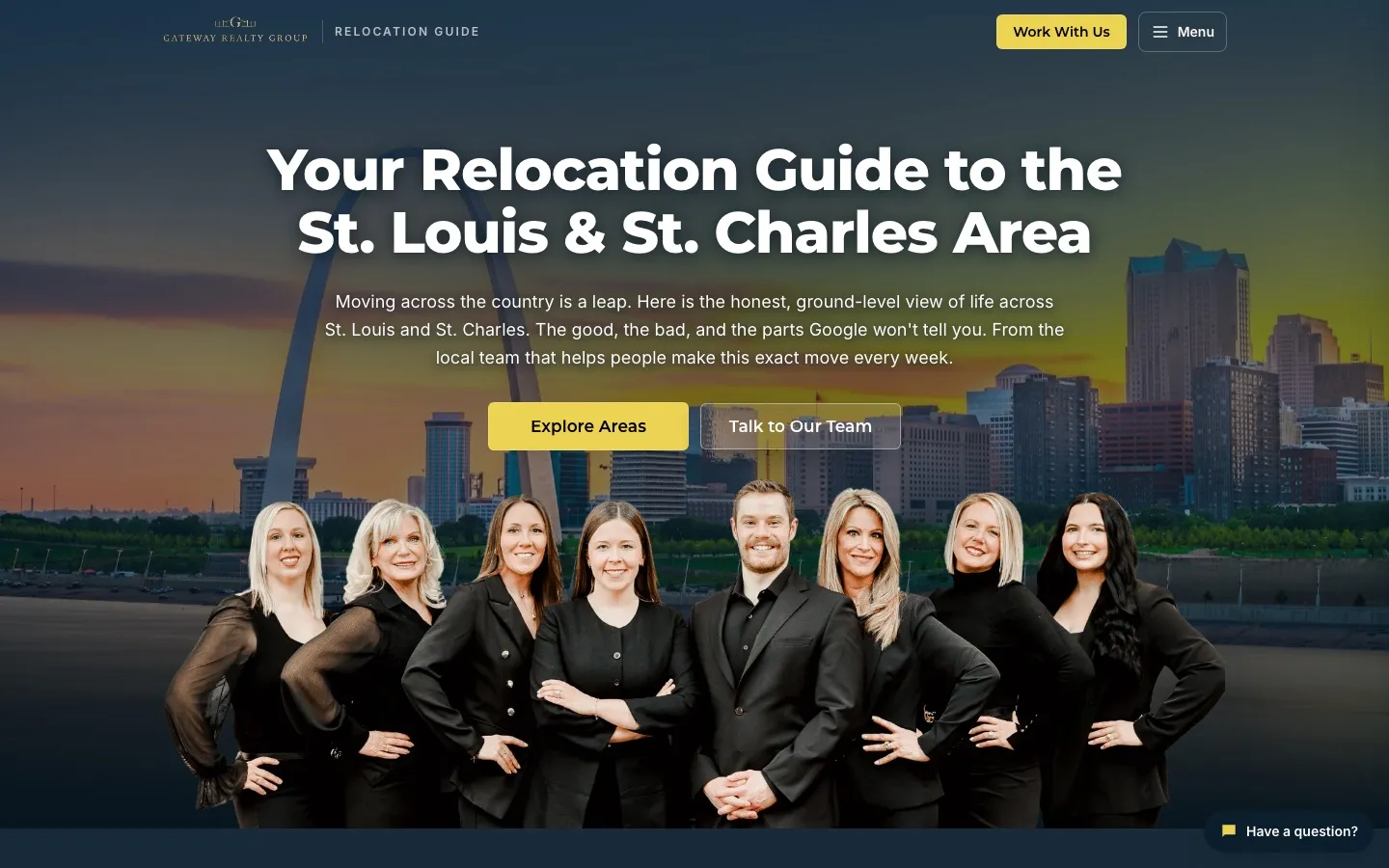
St. Louis Relocation Guide
An interactive St. Louis relocation guide that replaced a 26-page PDF.
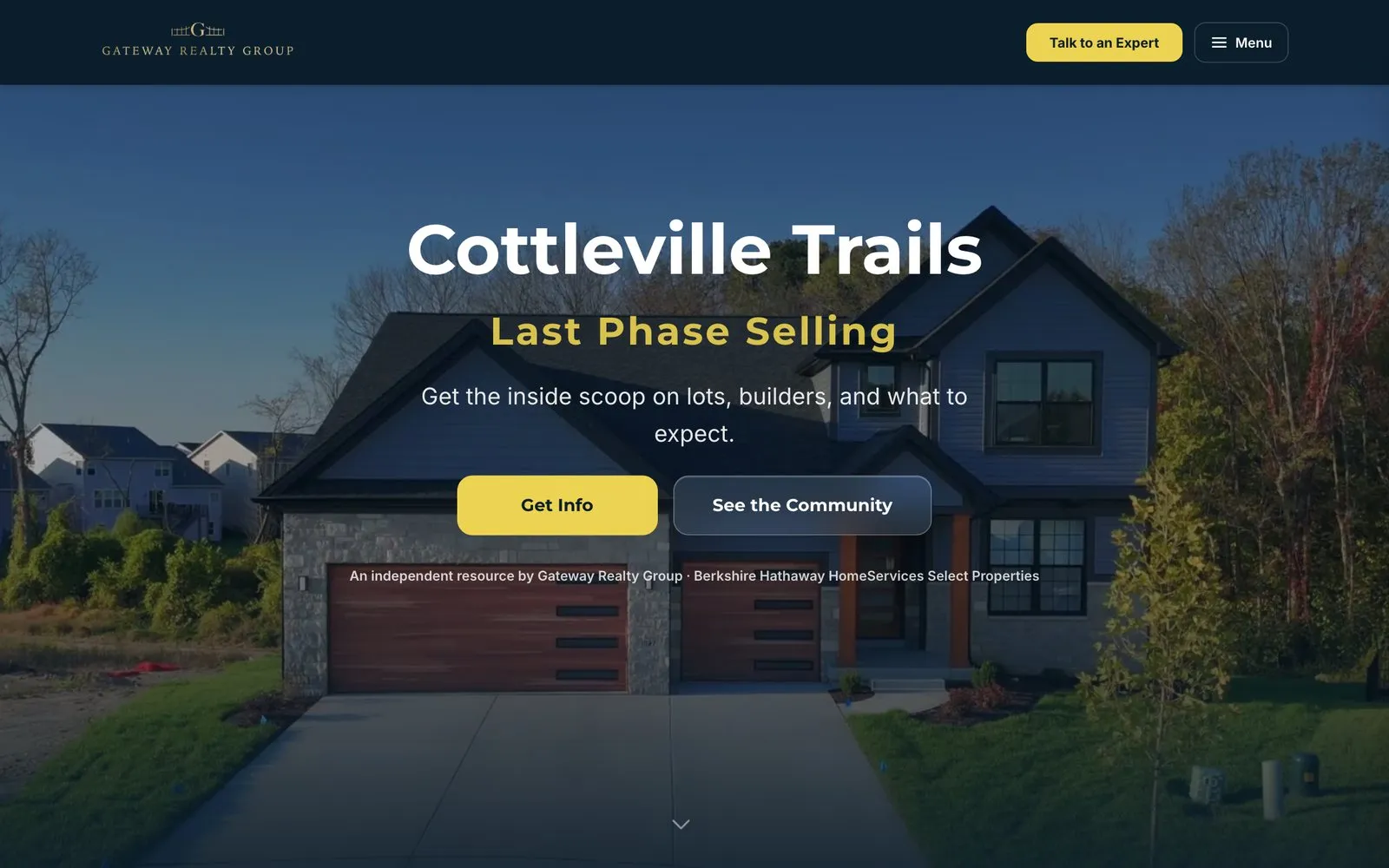
Cottleville Trails
A new construction community site with floor plans, available homes and buyer inquiries.
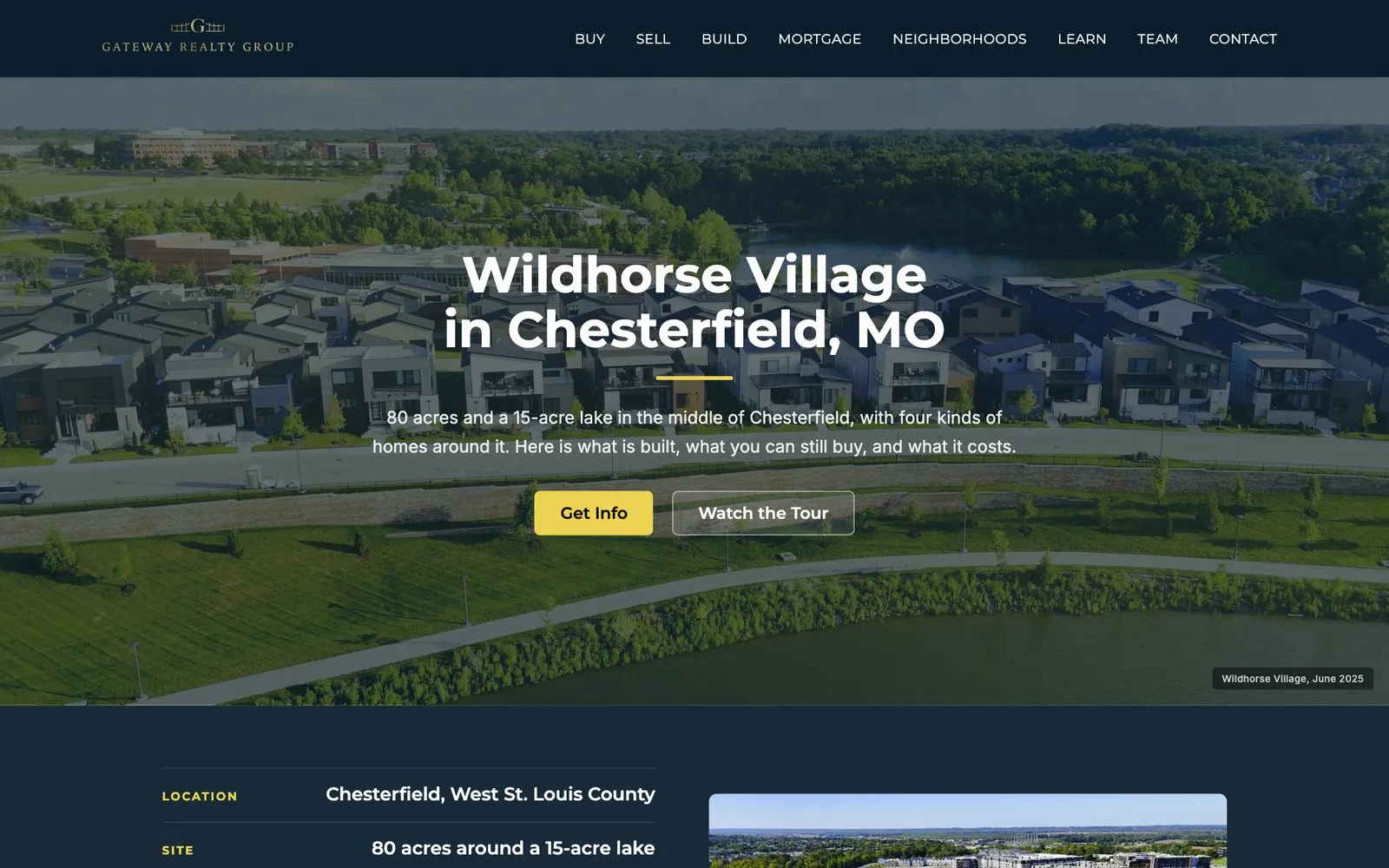
Wildhorse Village
A community guide covering what is built, what buyers can still buy and what it costs.
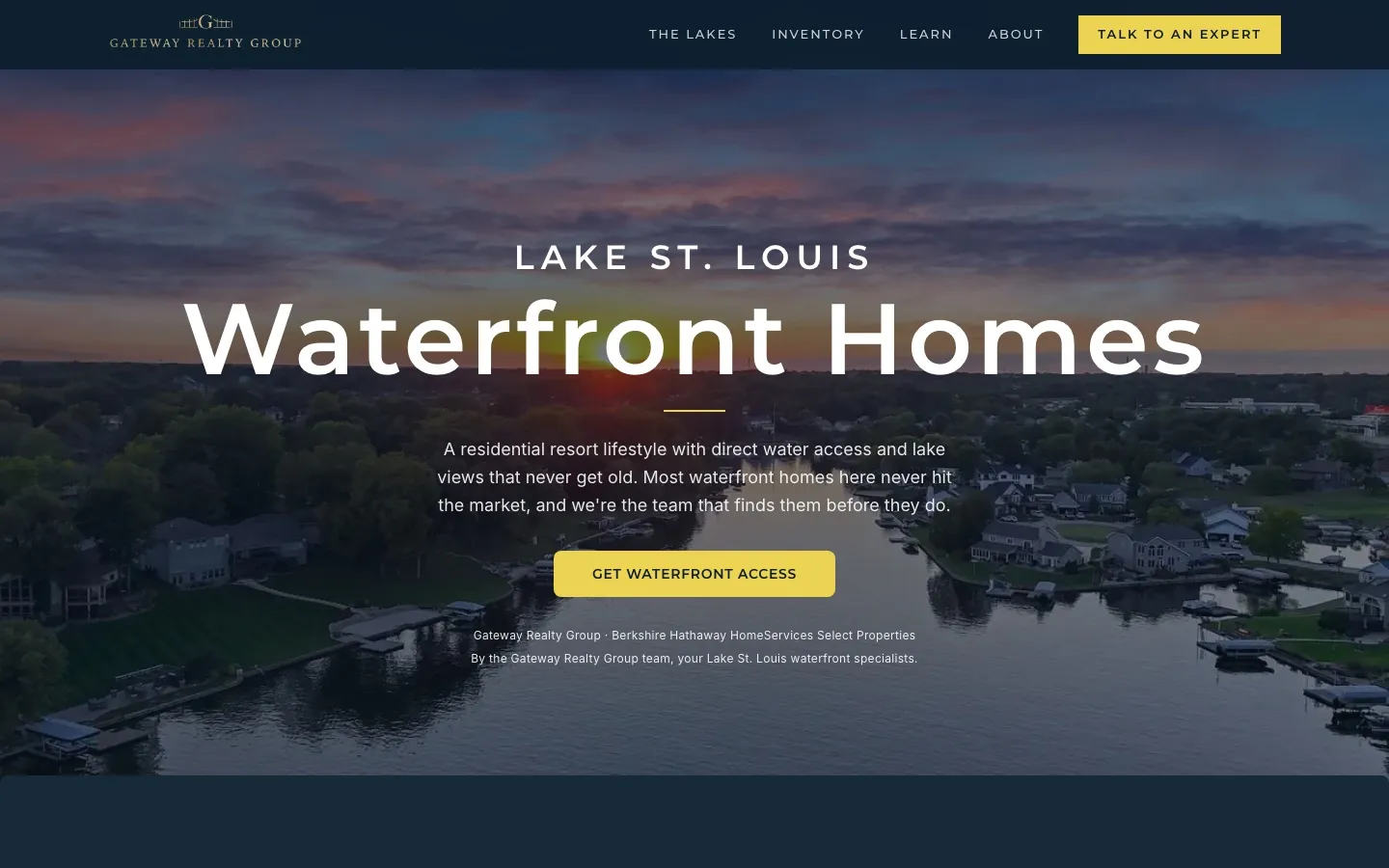
Lake St. Louis Waterfront Homes
Waterfront home guides and property information for Lake St. Louis.
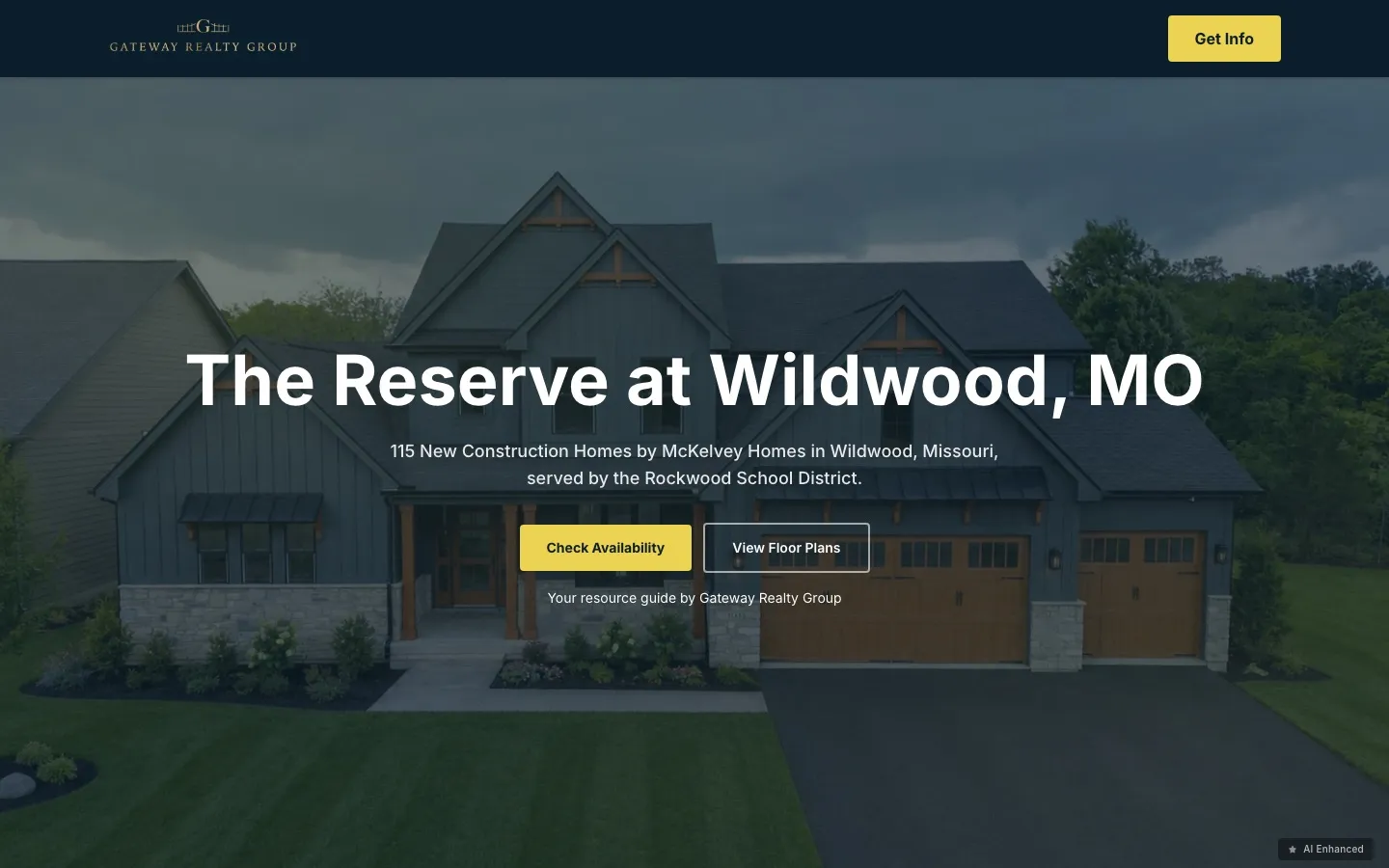
The Reserve at Wildwood
A lead site for a 115-home new construction community in Wildwood, Missouri.
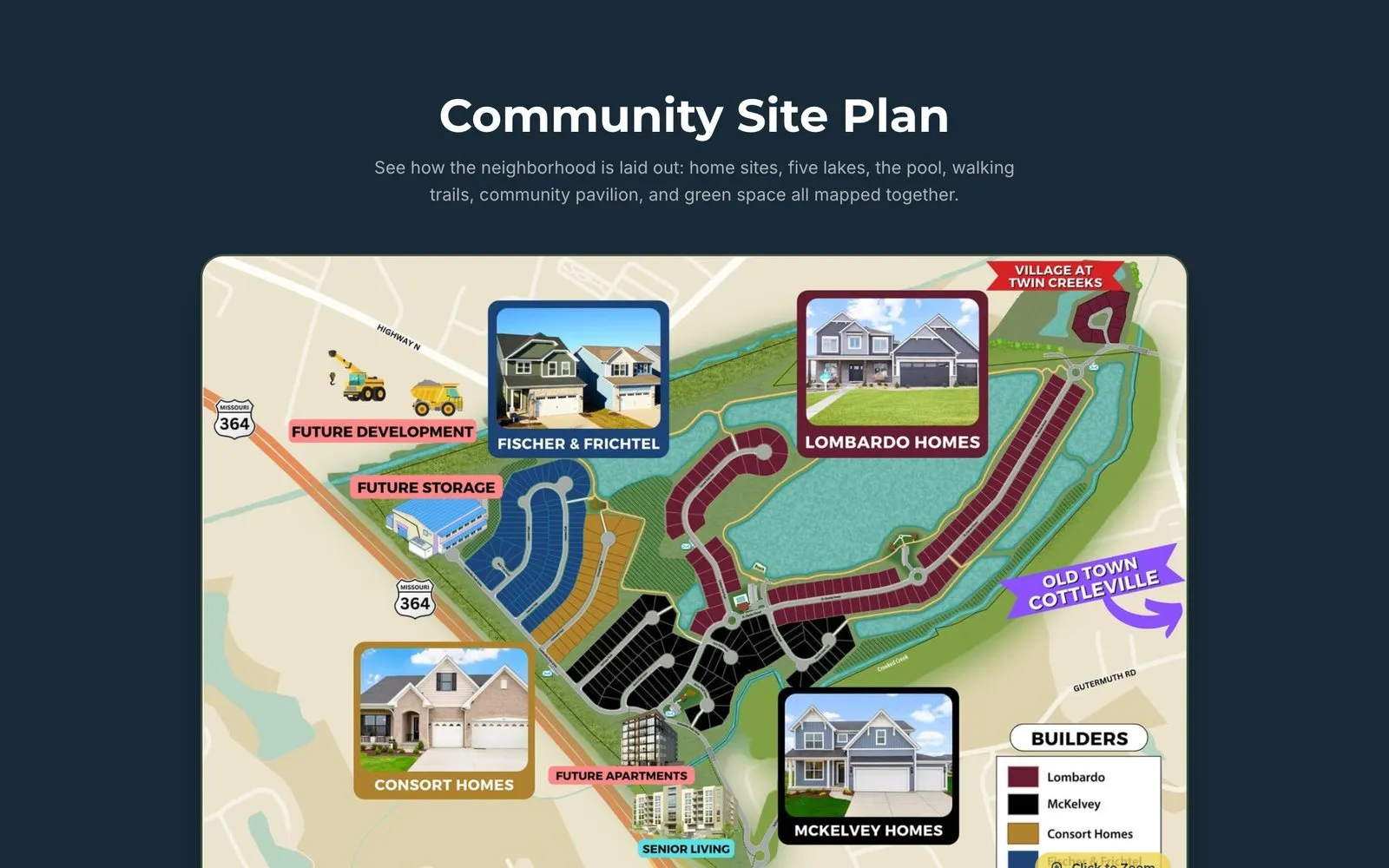
Cottleville Trails Site Plan
An illustrated site plan that shows every builder, lake, trail and future development in one map.
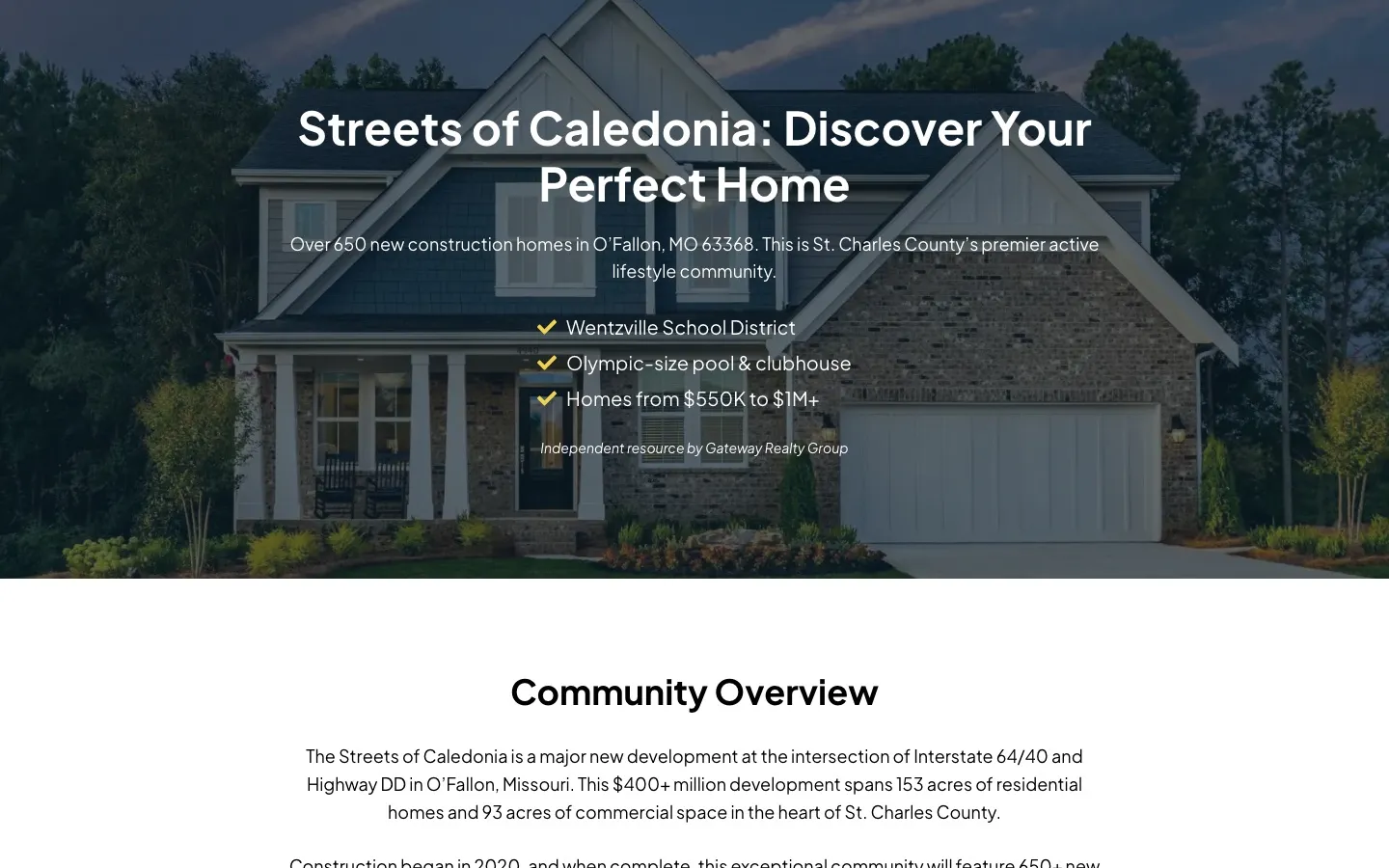
Streets of Caledonia
One page for a 650-home community in O’Fallon, Missouri, producing buyer leads for years.
What Your SEO Engagement Delivers
Every stage produces something you can see, review and use.
- 1Plan
Research Your Market
We study your website, competitors, local searches and today’s AI answers to find the pages and places worth winning.
- A prioritized search plan
- Keyword and competitor research
- A measurement baseline
What That Includes
- Bottom-of-funnel keyword research: agents, builders and homes for sale in specific areas.
- Search Console data and client questions over volume estimates.
- Competitive analysis of who ranks and how strong their domains are.
- A benchmark of rankings, AI prompts and inquiries before work begins.
- 2Build
Build the Foundation
The first months fix the foundation: your Google Business Profile, a review system and the website every page depends on.
- Your website, improved or rebuilt
- Google Business Profile and review system
- Technical SEO and lead tracking
What That Includes
- Google Business Profile, review system and website first.
- Technical SEO: crawlable HTML, title tags, meta descriptions, canonical tags, XML sitemap, HTTPS, schema markup and page speed.
- Commercial pages with clear conversion elements and a call-to-action that explain the problem, show proof and answer objections.
- 301 redirects for every valuable URL; forms, calls and bookings tracked in your CRM.
- 3Grow
Publish Pages That Help
Your local knowledge becomes the pages people use to compare options and choose who to call.
- Service and location pages
- Neighborhood and community guides
- Internal links that connect them
What That Includes
- Service and location pages first, then hub and spoke content clusters.
- Neighborhood guides, community pages, market reports, and buyer and seller guides that lead to booked showings and valuation requests.
- Original photos, local prices and firsthand detail AI cannot easily copy.
- Fair housing compliant copy with internal links to the pages that convert.
- 4Measure
Earn Authority
Links and mentions from trusted local sites build credibility, and monthly reports show which work turns into inquiries.
- Relevant mentions and links
- Search, AI answer and inquiry reporting
- Agreed next priorities
What That Includes
- Local link building: sponsorships, the chamber of commerce, local media and partners.
- Data people want to cite; no link farms or purchased links.
- Monthly reporting on keyword footprint, organic traffic, conversions and Google Business Profile actions.
- AI visibility in ChatGPT, Gemini, Claude, Perplexity and Google AI Overviews, judged against qualified leads.
Timing. The first months focus on your website and foundations. Content, authority and AI visibility work builds from there, usually 2 to 4 months after kickoff depending on build scope. We agree on the sequence before work begins.
Your Website and Search Strategy.
One Engagement.
Your visibility depends on what people find after the click. We connect real estate SEO, your website and lead capture so each part supports the next.
- Teams & BrokeragesBuyer and seller services, neighborhoods and relocation.
- HomebuildersCommunities, floor plans and available homes.
- Developers & CommunitiesThe place, the opportunity and a clear path to inquire.
Search & AI Visibility
From $2,500a month
Six-month minimum. Website build or rebuild included, with no separate build fee.
- Market research and a prioritized search plan
- Website, technical SEO and conversion foundations
- Useful content and relevant authority building
- Search, AI visibility and inquiry reporting
- You own your website, domain and content
A Practical Guide to Real Estate SEO
What moves real estate rankings and inquiries, in plain language. Open any topic for the details.
Real Estate Keyword Research
Find the searches that lead to a call, not just traffic.- Start with bottom-of-funnel, high-intent keywords: services, communities and homes for sale.
- Mix seed keywords, short-tail keywords and long-tail keywords with location-based keywords and property-type keywords; national SEO only suits regional websites or brands in many markets.
- Use Search Console impressions, clicks and real client questions over volume estimates.
- Judge the competitive landscape by the authority of ranking domains, not keyword difficulty alone.
- Give each page one search intent: broad transactional keywords belong on pages that convert, informational guides support them.
- Group searches as informational, navigational or transactional, and note SERP patterns like map packs and AI Overviews.
- Audience research and simple customer personas keep the plan tied to your target audience.
On-Page SEO for Real Estate Websites
Make every page clear about who it is for and where.- Main keyword in page titles, the first sentence, one H2 and a descriptive URL; internal linking connects related pages.
- One H1 heading, clear H2s and H3 headings, and lists and tables that can win featured snippets and rich snippets.
- Internal links with descriptive anchor text from guides to service and location pages.
- Alt text and captions that describe original, high-quality images.
- Focused commercial pages: no keyword stuffing, and no chasing content length or LSI keywords.
- Readability first, with descriptive URLs and breadcrumbs that show where each page sits.
- Image and photo optimization: compressed image files, alt attributes and captions.
Technical SEO Checklist
Make sure search engines can crawl, understand and trust the site.- Content in the HTML so crawlers can read it during crawling, not loaded only by JavaScript, with mobile-friendly designs that pass a mobile check.
- XML sitemap, robots.txt, canonical tags, HTTPS and a valid SSL certificate.
- Faceted navigation and IDX search pages controlled so thin, duplicate listing pages stay out of the index.
- Indexing checked with the site: search operator, the URL Inspection Tool and the Page indexing report; Google Search Essentials covers the basics, and noindex suits only utility pages.
- Redirect errors and error pages fixed; WebP images, lazy loading and caching matter most when pages are slow.
- Crawl budget and crawl efficiency matter on large listing sites; subdirectories beat subdomains for brand content.
- Review Why pages aren’t indexed and request re-indexing after major changes.
- Server location, HTTP/2 or HTTP/3, server caching and browser caching improve page performance.
Local SEO and Google Business Profile
Show up in the map results where most local searches start.- Google ranks the Local Pack by relevance, distance, and prominence, and word of mouth shows up as reviews and mentions.
- A verified address, steady customer reviews with positive ratings and the right primary category do most of the work; add service-area pages for each place you serve.
- Reply to every review; review monitoring keeps your overall rating and review stars current.
- Regular posts and Q&A keep the profile fresh but rarely move rankings.
- NAP consistency on the handful of directories AI tools cite, such as Yelp, Bing Places, Apple Maps, Facebook, the BBB or Yellow Pages, beats hundreds of citations.
- Verify your business, choose accurate categories and attributes, and keep business hours current.
- Online reviews on Google and independent review sites build trust; never buy them.
- LocalBusiness or RealEstateAgent schema and a Knowledge Panel help confirm who you are.
Content That Ranks and Converts
Publish the local answers buyers and sellers look for.- Pages built on experience or data: original photos, local amenities, schools, commutes and HOA fees.
- Market report pages, market analyses and infographics with price trends and price-per-square-foot data earn links and citations.
- Hub and spoke topic clusters build topical authority around service and location pages.
- Content planning with a calendar, plus a refresh whenever facts change; a market-focused strategy beats generic blog posts.
- Fair housing compliant copy that describes places, not the people they suit, and never deceptive or misleading content.
- Hyperlocal content: landmarks, population trends, average property value and nearby amenities.
- Thought leadership content and expert opinions give journalists and AI answers something to quote.
- Home valuations tools or an interactive mortgage calculator can earn links; do not gate your content before it helps.
Link Building and Digital PR
Earn mentions from sites your market already trusts.- Off-page SEO matters: links earned from trusted sites build link authority and pass PageRank, so start early.
- Start local: sponsorships, the chamber of commerce, local newspapers and other media outlets, professional organizations and local partnerships.
- Data assets, market insights and expert contribution opportunities earn high-quality inbound links.
- Ask whether a link would send business as an ad, and keep anchor text natural.
- Avoid link farms, comment spam and black hat techniques that risk a manual action.
- White-hat link building: manual outreach, relevant guest posts and digital PR.
- Competitors’ backlinks and a backlink profile comparison show realistic gaps in referring domains.
- Dofollow and nofollow media references both build recognition; skip automated directory submissions.
AI Search, AEO and GEO
Give AI answers accurate facts to cite about your business.- ChatGPT, Gemini, Claude, Perplexity and Google AI Overviews retrieve from search results, so SEO does most of the work.
- Answer engine optimization (AEO) and generative engine optimization (GEO) add corroboration from reviews, directories and portals like Zillow and Realtor.com.
- One consistent business description and consistent terminology everywhere.
- Short, standalone answers near the top of each section, written with human expertise, are easier to quote in AI-generated answers.
- JSON-LD schema markup describes visible facts; schema and llms.txt have no proven effect on AI answers.
- AI retrieval favors pages with clear headings, an About the Author line, author signals and reputable and relevant sources. Mass-produced AI content and AI-drafted blog posts without expert oversight rarely earn citations; AI traffic appears as referrals in Analytics.
Measuring Real Estate SEO
Track leads and closings, not just rankings.- Benchmark keyword tracking, AI visibility and lead flow before changing anything.
- Report keyword footprint, organic visits and sessions, impressions, clicks, click-through rate (CTR) and traffic lifts.
- Track GA4 key events and referral traffic: contact form submissions, calls and consultation bookings, connected to your customer relationship manager (CRM).
- Pages in positions 2 to 15 are usually the fastest wins.
- Judge ROI by qualified leads, close rate and closed transactions, not vanity metrics like bounce rate; heat maps and visitor engagement time reveal usability problems.
- Set KPIs and realistic targets, review search performance monthly in live dashboards, and use lead alerts and lead qualification so inquiries get fast replies.
- Return on investment (ROI): revenue from closed deals compared with your monthly budget.
What Real Estate SEO Costs
Know what you are paying for before you sign.- Most real estate SEO is a monthly retainer with a minimum term; projects may be billed at an hourly rate.
- Standard SEO service fees vary with the scale of your business and local competition; compare them with PPC (pay-per-click advertising) and its cost-per-click (CPC) spending.
- Pricing transparency: ask what the monthly tasks are, what is delivered and how results are reported.
- Be wary of fixed link counts and guaranteed rankings.
- Ours starts from $2,500 a month with a six-month minimum, website build or rebuild included.
- Ask how additional development or design work is priced, and budget for ongoing optimization.
Choosing a Real Estate SEO Company
Ask for proof, process and plain reporting.- Verifiable real estate work, case studies with dates and sources, and a sample monthly report.
- A clear approach to keyword research, technical fixes, content creation and link building.
- A written SEO roadmap tied to your target outcomes.
- Warning signs: guaranteed rankings, short results roadmaps and promised monthly link counts.
- You own the website, domain, content and data.
- Ask about qualifications, notable clients and who handles campaign implementation.
Video, Social and Voice Search
Turn the questions you answer on video into search visibility.- YouTube is a top source AI tools cite for informational queries, and they read the transcript.
- Neighborhood tours and market updates can rank on Google and YouTube.
- Embed each video on the matching page to support both.
- Video marketing and social media suit top-of-funnel topics that lead back to your site.
- Answer conversational voice search questions directly on your pages, and feature genuine user-generated content such as client reviews.
- Newsletters and social media promotion put new guides in front of past clients.
IDX, MLS and Listing Pages
Use listing feeds without letting them crowd out your own pages.- An IDX integration or MLS feed repeats data found on many sites, so listing pages rarely rank alone.
- Index a few curated searches, such as homes for sale in a neighborhood, paired with original content.
- Avoid thousands of thin, templated or dynamic neighborhood pages.
- Property search filters for bedrooms, bathrooms and price help visitors but should not all be indexed.
- Complete Zillow and Realtor.com profiles; AI tools often cite listing portals.
- Fresh MLS listings serve buyers; your original pages earn the rankings.
SEO for Agents, Teams and Brokerages
Build visibility for the brand and the people behind it.- A strong brokerage brand site plus agent pages with experience, areas and reviews.
- Consistent agent names, bios and profiles across Google, Zillow, Realtor.com and LinkedIn, because AI answers often name individual agents.
- A Google Business Profile and location page for each office.
- Brand and agent pages that target different searches, avoiding keyword cannibalization.
- The transaction experience explained plainly on every page.
- Agent bios with clear author signals show the expertise, authority and trustworthiness (E-E-A-T) readers look for.
Choosing a Website Platform
Pick a platform you can keep fast, secure and easy to update.- Content management systems (CMS) matter less than how the site is built and the user experience (UX) it delivers.
- Good web design matters more than the platform: WordPress with an SEO plugin such as Rank Math, or a modern static build, can rank when content is in the HTML and plugins or scripts stay lean.
- A reliable hosting provider and easy editing for your team.
- Ownership of your domain and content, keeping the same domain and TLD for continuity.
- Website upgrades and migrations planned with a redirect map and clear technical requirements, expecting a temporary dip.
- A CMS your website manager can update without a developer.
Common Real Estate SEO Mistakes
Avoid the errors that quietly cap results.- Thin location pages copied across cities and thousands of indexable IDX pages.
- Every city in the navigation, and a phone number in the page title.
- Redesigns launched without redirects, and over-optimized copy.
- Buying links, ignoring the Google Business Profile and inconsistent business details.
- Leads never connected to the CRM, and low-quality pages left up instead of deleted.
- A site migration without a redirect map, and spammy links that invite a manual action.

Work With Someone Who Knows the Questions.
Jacob Peistrup built Living St. Louis around people moving to and around the region. Their questions arrive in comments, messages and inquiries, giving the work a direct connection to what people need before they choose.
Formbreak brings that perspective to your market: learn your business, surface your expertise and build pages that help the right clients take the next step.
If buyers ask it, your website should answer it.
Real Estate SEO.
Your Questions, Answered.
The scope, investment and expectations to understand before choosing an SEO company.
What Is Real Estate SEO?
Real estate SEO helps agents, teams, brokerages, homebuilders and developers appear when buyers and sellers search on Google, in Google Maps and in AI answers. It combines technical SEO, focused landing pages, local SEO, real estate content and links, turning organic visibility into buyer and seller leads on a website you own.
What Is Included in Your Real Estate SEO Services?
Keyword research, your Google Business Profile and review system, a website build or rebuild, technical and on-page SEO, content writing, local link building and monthly reporting. We start with an audit of your site, competitors and current AI answers, then agree on priorities for your market.
How Much Does the Engagement Cost?
Search and AI visibility starts from $2,500 a month with a six-month minimum, and your website build or rebuild is included with no separate build fee. The first months focus on foundations; broader content, authority and AI visibility work follows, usually 2 to 4 months after kickoff depending on scope.
Is Paying for Real Estate SEO Worth It?
It can be, because it builds an asset you keep. PPC advertising and portals such as Zillow or Realtor.com stop sending leads when spending stops, while ranking pages, reviews and links keep working and reduce portal dependency. We judge ROI by qualified leads and closings, not traffic alone, and never promise rankings.
Do You Work With Real Estate Teams and Brokerages?
Yes, along with homebuilders, developers and communities across the United States. A brokerage may need buyer and seller service pages and neighborhood guides; a builder may need community, floor plan and available-home pages. The plan follows what you sell and where.
Should We Hire an SEO Agency, a Freelancer or Do It In-House?
A freelancer suits a defined project; in-house SEO works if you already have writers, a developer and someone who owns reporting. An agency fits when you want the website, technical SEO, content and links handled together. Whoever you choose, ask for verifiable work, a clear scope and transparent pricing.
What Kinds of Leads Does Real Estate SEO Produce?
Buyer consultations, showing requests, seller valuation requests and relocation questions for teams and brokerages; floor plan, available-home and community inquiries for builders. Unlike shared portal leads, they come to your team alone, and CRM routing and follow-up are agreed during scoping.
How Long Does Real Estate SEO Take?
Expect early movement in a few months and significant traction in roughly 8 to 12 months; a brand-new domain usually takes longer. Your starting site, links, reviews and competition all affect the pace. The six-month minimum gives the work a defined runway; it is not a promise of a ranking or lead count.
Can You Improve Our Existing Website?
Usually, yes. Existing rankings and links are valuable, so we improve a site that can support the strategy and rebuild only when it holds you back. We keep your domain, because a new domain can take many months to earn trust.
Will a Website Redesign Hurt Our Rankings?
Expect a temporary dip; settling can take 3 to 6 months. We reduce the risk by mapping every valuable URL to a 301 redirect, keeping the domain, avoiding unnecessary content changes during the move and checking Search Console for 404 errors and indexing issues after launch.
How Do You Choose Which Keywords to Target?
Bottom-of-funnel keywords come first: your services, communities and homes for sale in specific places. Local volume estimates are unreliable, so Search Console data and real client questions guide the plan, and we build important pages even when tools show low volume. Each page targets one search intent.
How Do You Measure Whether SEO Is Working?
We benchmark rankings, AI visibility and inquiries before changing anything, then report keyword footprint, organic traffic, Google Analytics 4 conversions, calls and booked consultations. Agreed CRM integrations add lead status and source. We separate observed results from estimates.
How Is AI Search Optimization Different From SEO?
AI tools such as ChatGPT, Perplexity and Google AI Overviews mostly retrieve from search results, so strong SEO does most of the work. AI optimization adds third-party corroboration: reviews, directories, listing portals and one consistent description of your business. No one can guarantee an AI citation.
Do We Need Special Schema to Appear in AI Answers?
No. Google says no special structured data is required for its AI features, and there is no evidence schema changes AI answers. We still add accurate schema markup, such as Organization, Service, FAQPage and BreadcrumbList, because it describes visible facts clearly.
What Does Local SEO Involve?
Google ranks local results by relevance, distance, and prominence. A verified address, steady reviews and the right primary category do most of the work. We keep your business details consistent on the directories AI tools cite and build pages for the places you serve. A website alone does not decide Maps rankings.
Will You Write Our Neighborhood and Service Pages?
Yes. Pages are built from your local expertise, client questions and verified facts: original photos, prices, commutes and firsthand detail. We avoid interchangeable city pages that swap a place name, and connect each guide to the service page that converts.
Do You Use AI to Write Content?
We use AI for research and drafting, but the value comes from the inputs only you have: local knowledge, data, photos and client questions. A person edits and fact-checks every page. Mass-produced AI content without those inputs adds little and tends to fade.
Do You Work With Luxury Real Estate or Multiple Locations?
Yes. Luxury pages lean on photography, architecture and specifics high-end buyers compare. For multiple locations, each eligible office gets its own Google Business Profile and location page; secondary cities can start on one strong page and split into their own pages when demand shows.
Do You Build Backlinks?
Yes. Links remain one of the strongest ranking levers, so link building starts early. Local sponsorships, the chamber of commerce, local media, partners and data people want to cite come first. We report links as outputs, never a fixed monthly count, and avoid link farms and purchased links.
Do We Own the Website and Content?
Yes. You own your website, domain and content, and inquiries go to your team. Access, integrations, hosting and maintenance are clarified in the proposal so you know what is included.
Is SEO Still Worth It With AI Search in 2026?
Yes. Local searches are among the least affected by AI, and Google still handles most of them. AI answers draw on pages that rank, so the same foundations matter. More questions are answered before a click, so we measure inquiries, not traffic alone.
How Do You Show Experience and Trust on Our Website?
Real agent and team profiles, clear authorship, original photos, dated market data, honest reviews and verifiable proof. Google’s quality guidelines call this E-E-A-T, and real estate is a Your Money or Your Life topic. Authority in rankings still comes mostly from links and mentions. We never invent testimonials or results.
Do You Work With IDX, MLS Feeds or Zillow Profiles?
Yes. IDX listing pages repeat MLS data found on many sites, so we index only a few curated searches and pair them with original pages. Portal profiles matter too: AI tools often cite Zillow and Realtor.com, so we help keep those profiles complete and consistent with your site.
Do You Sell Leads or Run Paid Advertising?
No. This engagement builds your own search visibility and lead-generation website, and inquiries belong to your business. Paid ads, purchased leads and portal subscriptions are outside this offer; we account for them when setting measurement.
What Happens on the Intro Call?
A free 30-minute call with Jacob Peistrup, founder of Formbreak. He reviews your website first. Bring your target markets and goals; you leave knowing whether the engagement fits and what should happen first.
Let’s Find Your Next
Search Opportunities.
Book a free 30-minute call with Jacob. He reviews your website first, then you’ll talk through your target markets and where to start.